Field Notes · Gear
Clothing that doesn't give you away
Three criteria, in this order: it shouldn't make noise, it shouldn't stand out, and it should keep you comfortable while standing still. Almost everything else is marketing. A soft fleece flushes fewer birds than a top-of-the-range crinkly waterproof.
Birds react to movement, silhouette and sound before exact colour. Dressing well for the field is, above all, learning not to draw attention.
Three criteria
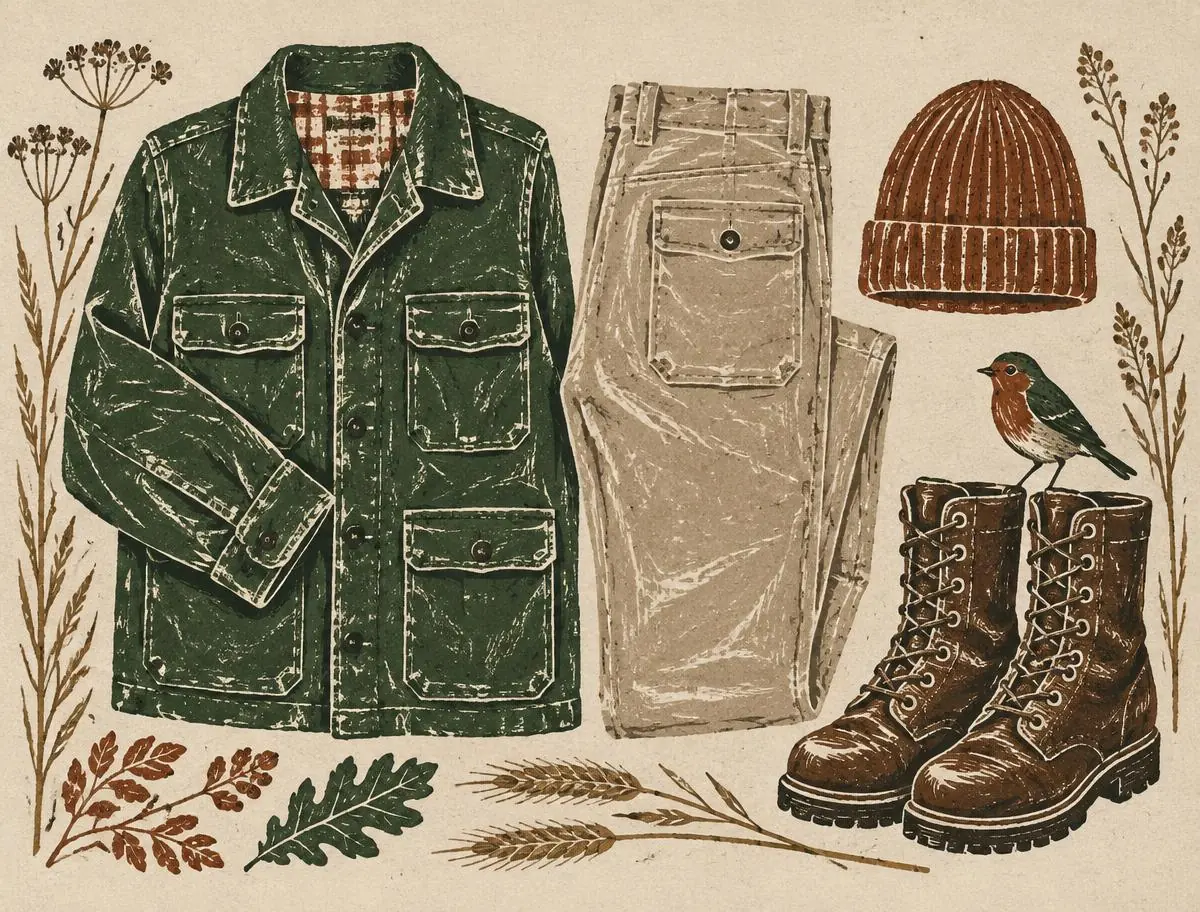
Silence, tone, layers
Fabric that doesn't rustle, a muted matte colour, and a layering system that works while standing still for two hours. In that order.
Why does fabric noise matter so much?
Because the swish of an arm raising binoculars makes a sound, and it carries perfectly clear at ten metres. Very stiff technical fabrics, shiny nylon and some cheap waterproofs produce a dry crackle that's completely foreign to a forest.
The test is simple and you can do it in the shop: close your eyes, raise and lower your arms, twist at the waist. If you can hear yourself, so can the bird. Compare that same motion in a dense cotton shirt or a fleece and you'll notice the difference instantly.
Watch out for metal details too. Dangling zip pulls, buckles, carabiners and trouser rings jingle as you walk. A couple of wraps of tape, or tucking them away, fixes the problem for good.
Do you need to wear camouflage?
No. Muted, matte tones are enough: olive green, sand, grey, brown, washed-out blue, charcoal. What really draws attention is saturated colour, a large area of white, and any shiny surface that reflects light.
Birds are excellent at spotting movement and silhouette. You can be dressed in perfect green and still clear a shoreline if you suddenly stand up against the skyline. That's why colour is only half the answer: the other half is moving slowly and breaking up your outline with vegetation, a wall, or the hide itself.
Avoid white on your hands and face if you'll be close: a neck scarf and a plain cap noticeably reduce the amount of pale, moving surface when you raise your binoculars.
What do you wear if you'll be standing still for two hours?
With three layers, and accepting that standing still gets you far colder than walking. A base layer that manages sweat from the walk in, an insulating mid layer such as fleece or wool, and a windproof outer shell. What matters is being able to add or shed layers without stripping down completely.
Start the walk wearing less than you feel like: arriving at a hide sweaty is a guarantee you'll get cold afterwards. Put the insulating layer on when you arrive, before you're cold, not once you already are.
Extremities first: a hat, thin gloves that still let you turn the focus wheel, and wool socks. If your hands get cold, you'll stop using the binoculars, and the outing is over even if you're still sitting there.
What footwear and what backpack?
Choose footwear by terrain, not by catalogue. For wetlands and dirt tracks, a mid waterproof boot is plenty. For muddy marshes and rice paddies, tall wellingtons. For hills, something with good grip and ankle support if you're carrying weight.
Choose your backpack by how it opens. One you can open without taking it off or making noise beats one with twenty pockets. Make sure the zips don't hiss and water is easy to reach: in a hide, you don't want a whole rummage every time you're thirsty.
Two specific pieces fit naturally here: an embroidered field cap in matte cotton, which cuts glare and shades the face without shining, and a dense organic cotton sweatshirt, which keeps you warm through long waits without the rustle of stiff synthetic fabrics.
What changes between summer and winter?
In summer, the enemy is sun and insects. Thin, muted-light long sleeves, a cap, and protection for the neck and hands. Thin long sleeves are more comfortable than sunscreen on multi-hour outings, and they prevent scratches from vegetation.
In winter, the enemy is stillness. Add an extra insulating layer and something insulated to sit on: cold comes in through wherever you're resting. A spare pair of gloves in the backpack saves whole mornings of fog or drizzle.
During passage season, with early starts and sharp temperature swings between dawn and eleven o'clock, the key is being able to shed layers in stages without taking your eyes off the shore. Think of clothing as a system, not an outfit.
Quick checklist before you go
- Noise test: move your arms with your eyes closed.
- Muted, matte tones, no large patches of white.
- Three layers plus a spare for long waits.
- Hat, thin gloves and wool socks in cold weather.
- Zips and buckles secured so they don't jingle.
- A backpack you can open quietly without taking it off.
Frequently asked questions
Does regular hiking clothing work?
Almost always, apart from very crinkly waterproofs and saturated colours. Everything else adapts perfectly well.
Cotton or synthetic?
Dense cotton for mid and outer layers, for quiet and feel; synthetic or thin wool for the base layer, since it dries faster.
Is camouflage essential for photography?
No. Distance, using hides and patience matter far more than the pattern on your clothes.
Dressing to stay still
The best field clothing is what lets you stand still for two hours without thinking about it. If you notice it, something's wrong or something's missing.
If you're after dense, matte fabrics, the shop has the field cap and the organic cotton sweatshirts.
Visit the shop