Field Notes · Raptors
Identifying raptors when all you see is a silhouette
Against the light there's no color, so forget the plumage. Look at four things: wing shape, tail shape, how it holds its wings while gliding, and what it's doing. Those four clues solve most of the raptors you'll see from a road or a mountain pass.
The classic mistake is waiting to see details that will never appear. The right move is reading the silhouette in the first three seconds, before it moves away.
Four clues
Wing, tail, glide, behavior
Wing proportion, tail shape, whether it glides flat or in a V, and what it does in the air. That order solves more identifications than any plumage detail.
What wing shape does it have?
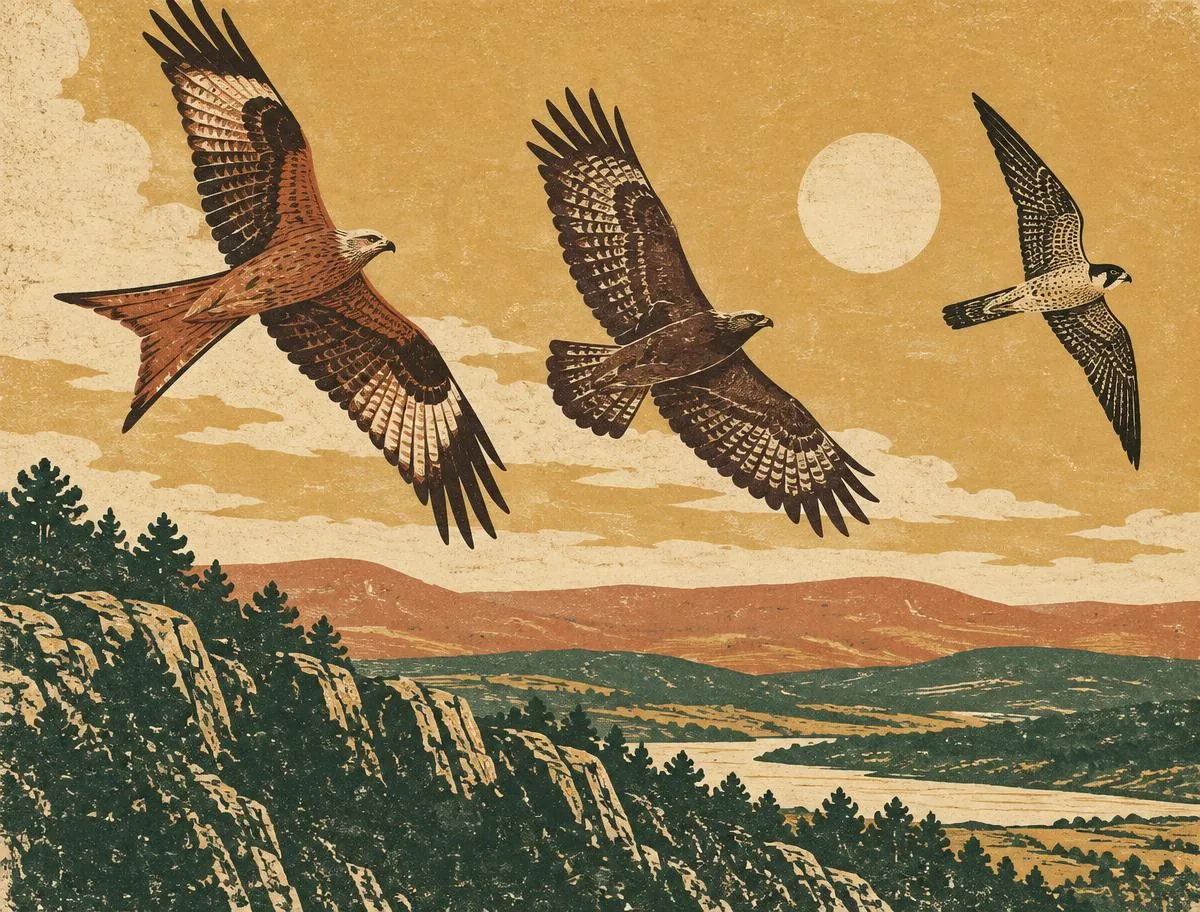
Mentally divide into three groups. Broad wings with marked "fingers": thermal gliders, like vultures, eagles and buzzards. Long, narrow, pointed wings: falcons, built for speed. Short, rounded wings with a long tail: goshawk and sparrowhawk, designed for maneuvering between trees.
Also notice the ratio between wing length and width. A booted eagle has long, relatively straight wings; a buzzard's are shorter and broader relative to its body. With practice, that proportion registers before any marking does.
And look at the head. On a griffon vulture the head barely projects; on an eagle it does, quite a lot. It's a surprisingly reliable clue at great distance.
What shape is the tail?
Forked and very mobile: kite. The red kite's is deeply forked and it constantly uses it as a rudder; the black kite's is less pronounced. If you see a tail twisting nonstop, you've already ruled out half the group.
Short, wedge-shaped tail: griffon vulture. Long, rounded tail with short wings: goshawk or sparrowhawk. Medium tail, often fanned open while gliding: common buzzard, the most frequent raptor on roads and poles.
In the bearded vulture the whole silhouette looks like something else: long, narrow wings and a long, clearly diamond-shaped tail. Once you see it, you never forget it.
How does it hold its wings while gliding?
Flat, rigid wings: eagles and buzzards, though the buzzard usually holds them slightly raised. Clear V-shape with constant rocking, flying low over reedbeds, grassland or crops: harriers. That slow rocking and low-altitude flight is almost a signature.
Fast, direct wingbeats, without long glides: falcon. A traveling peregrine seems to be in a hurry even when it's not hunting. A kestrel, on the other hand, stops in midair and hovers over a spot, something almost no other raptor does sustainedly.
And check if it gains height in circles without flapping: that's a glider using a thermal. If you see several together spiraling up mid-morning, you've got a good stretch of watching ahead.
What do location and date tell me?
Habitat filters enormously. A marsh harrier over reedbeds, a lesser kestrel in a village with a rooftop colony, a buzzard on a pole in open country, or a goshawk crossing a pine clearing: the scene already suggests the name before you look at details.
Date matters too. Many raptors are summer visitors: the honey buzzard, the booted eagle or the hobby are usually absent in the depths of winter across much of the peninsula. If you think you see one in January, check regional records before logging it.
At passes and straits, during migration, hundreds of birds pile up at specific hours. Check local watchpoint information before choosing a spot: during migration, location matters more than gear.
How do I practice without getting frustrated?
Start with the most common species in your area and watch it a hundred times. Once you know the buzzard well, anything that "doesn't fit" stands out on its own. That's how most interesting raptors are found: by contrast with the usual.
Sketch silhouettes in your notebook, even if you draw badly. Drawing forces you to look at proportions. Two wing strokes and a tail are enough for the comparison with the guide to make sense once you're home.
Accept the "unidentified raptor" entries. They're part of the craft. An honest note with four data points helps you learn; a name assigned out of pride is worth nothing.
Frequently asked questions
How do I estimate size in the sky?
By comparison: with a nearby crow, gull or buzzard. Absolute size is impossible to judge without a reference.
Do blurry photos help?
A lot. A bad photo usually shows wing and tail shape, which is exactly what you need.
Do juveniles complicate identification?
Yes, because plumage changes over years. It's another reason to rely on silhouette and behavior.
Look up mid-morning
Thermals start when the ground heats up. If you can only go out for a while, pick mid-morning with soft sun and a high point with clear sky.
And remember that no identification justifies approaching a nest or a breeding roost.
Back to Field Notes