Field Notes · Parks II
Tide, ancient forest and tundra: five northern parks
The first five parks in the collection looked south: deltas, marshes and Iberian mountains. These five change climate and method. Here the tide rules, along with fog, short winter light, and a forest no one has logged in millennia.
Each one demands a different way of watching. One is planned with a tide table, another with silence, another with mountain patience.
Five landscapes
From mud to glacier
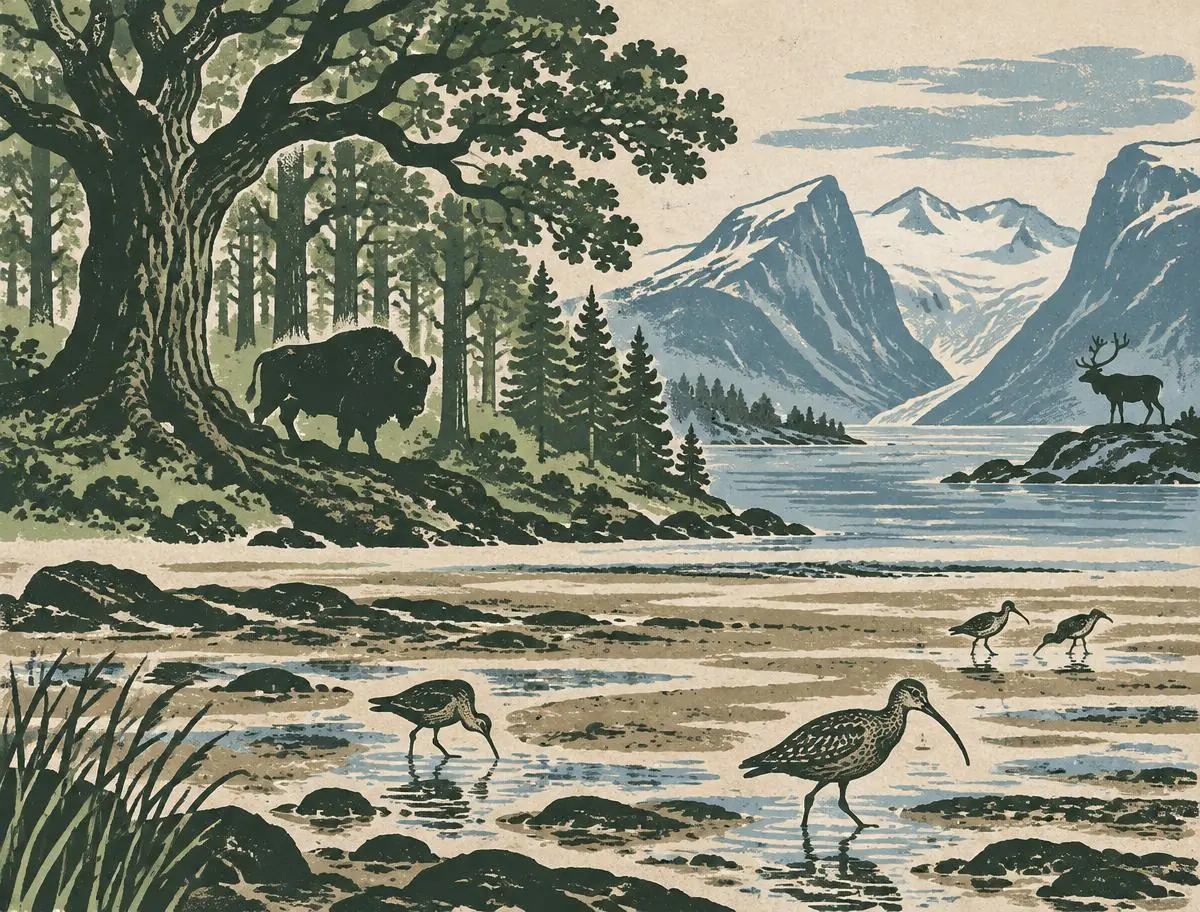
006 Wadden Sea · 007 Plitvice · 008 Białowieża · 009 Lake District · 010 Jotunheimen. Tide, limestone water, primeval forest, glacial lakes and Arctic high mountains.
006 · Wadden Sea: the park that appears and disappears
The Wadden Sea is the largest continuous tidal flat in the world, spanning the Netherlands, Germany and Denmark. Twice a day the sea retreats and leaves kilometers of mud loaded with invertebrates. That mud feeds millions of migrating waders: it's the service station of the eastern Atlantic.
Here you don't plan by the clock, you plan by the tide. At low tide the birds spread out far away and look tiny; as the tide rises they concentrate on the shore and pass close by. The good window is the two hours before high tide, from a fixed spot, without walking toward them.
Besides birds there are common and grey seals resting on sandbanks. The rule is simple: if they all lift their heads at once, you're too close. And don't cross the flats without a guide: the tide comes back faster than you can walk.
007 · Plitvice: water that builds the landscape
The lakes of Plitvice, in Croatia, aren't separated by rocks: they're separated by travertine barriers that the water itself builds, layer by layer, with carbonate and moss. The landscape is still growing today, very slowly, which is why the walkways are where they are.
For birds, the interest lies in the forest, not the waterfalls: woodpeckers, flycatchers, warblers and the dipper searching for invertebrates under fast water. It's a place where waterfall noise drowns out songs, so it's worth stepping away from the water to listen.
It's also one of the most visited parks in Europe. If you can, go early or outside peak season: the difference between 7:30 and 11:00 is the difference between a forest and a queue.
008 · Białowieża: what an unlogged forest sounds like
Białowieża, between Poland and Belarus, preserves one of the last fragments of European lowland primeval forest. What makes it different isn't the big trees: it's the dead wood. Fallen trunks, hollow stumps and rotting branches sustain a fauna that disappears in managed forests.
That detail explains its bird list: grey-headed woodpecker, white-backed woodpecker, middle spotted woodpecker and collared flycatcher are species tied to old wood. Presence changes with the season and some sectors have restricted access, so check official information before entering. It's a forest for watching trunks, not treetops.
It's also home to the European bison, saved from extinction from a handful of captive individuals. Seeing one at a distance, in the fog of a clearing, is one of those experiences that reshapes your idea of Europe.
009 · Lake District: a landscape worked for centuries
England's Lake District is a glacial landscape combed by centuries of grazing: U-shaped valleys, elongated lakes and miles of dry-stone walls. It's not untouched nature, and that's exactly what makes it interesting: it's an example of how a cultural landscape can sustain wildlife if managed well.
On the open slopes there are clues of field birds: pipits, wheatears, stonechats and, with luck, a peregrine falcon over the crags. Each wall is a perch and a highway for small birds; following a wall with binoculars is more productive than scanning the whole slope.
The weather rules. Here rain isn't the exception, it's the operating system. Gear that still works wet, layers, and realistic expectations about visibility.
010 · Jotunheimen: few species, a lot of meaning
In Norway's high mountains the species list shrinks and every sighting carries more weight. Ptarmigan changing plumage, water pipit, rock ptarmigan among the boulders, snow bunting on the snowfields, and reindeer moving across the plateau in the distance.
Observation changes scale: instead of looking for movement in a hedge, you scan whole slopes for a moving speck. It helps to lean on a rock, divide the terrain into strips, and sweep them slowly with binoculars.
It's also the most fragile landscape in the collection. Tundra vegetation takes years to recover from an off-trail footstep, and ground-nesting birds have nowhere to hide. Sticking to the marked trail isn't bureaucracy: it's the only way to leave no trace for a decade.
Quick checklist before you go
- Tide table checked if you're heading to the Wadden Sea.
- Early morning reserved for the heavily visited parks.
- Waterproof layers that don't rustle when you move.
- Park rules read before getting out of the car.
- Marked trails, especially in tundra and dunes.
- Distance from large mammals: binoculars, never approach.
Related designs
Frequently asked questions
Which park is easiest to start with?
The Wadden Sea: there are hides, comfortable access, and plenty of birds concentrated as the tide rises.
Do you need a local guide?
In tidal flats and high mountains, it's advisable. In forest and lakes you can go on your own following the marked routes.
What's the best season?
Migration passage for the coast, spring for the forest, and short summer for the Norwegian mountains. Check each park's official information before setting dates.
Ten parks, ten ways of looking
With the five from the south and these five from the north, the collection's map is complete: delta, marsh, limestone mountains, tide, primeval forest and tundra.
Each numbered garment corresponds to a park and its key species.
View the European Natural Parks collection