
Field Notes · Migration II
Five more travelers: from the bee-eater to the goose
The first installment told distance records. This one tells strategies: crossing a desert in noisy groups, crossing an ocean to hunt, doubling your weight before leaving, inheriting a map nobody taught you, and traveling as a family against the north wind.
These are the birds of designs 06 to 10 of Migration is Natural. Five different ways of solving the same problem: arriving.
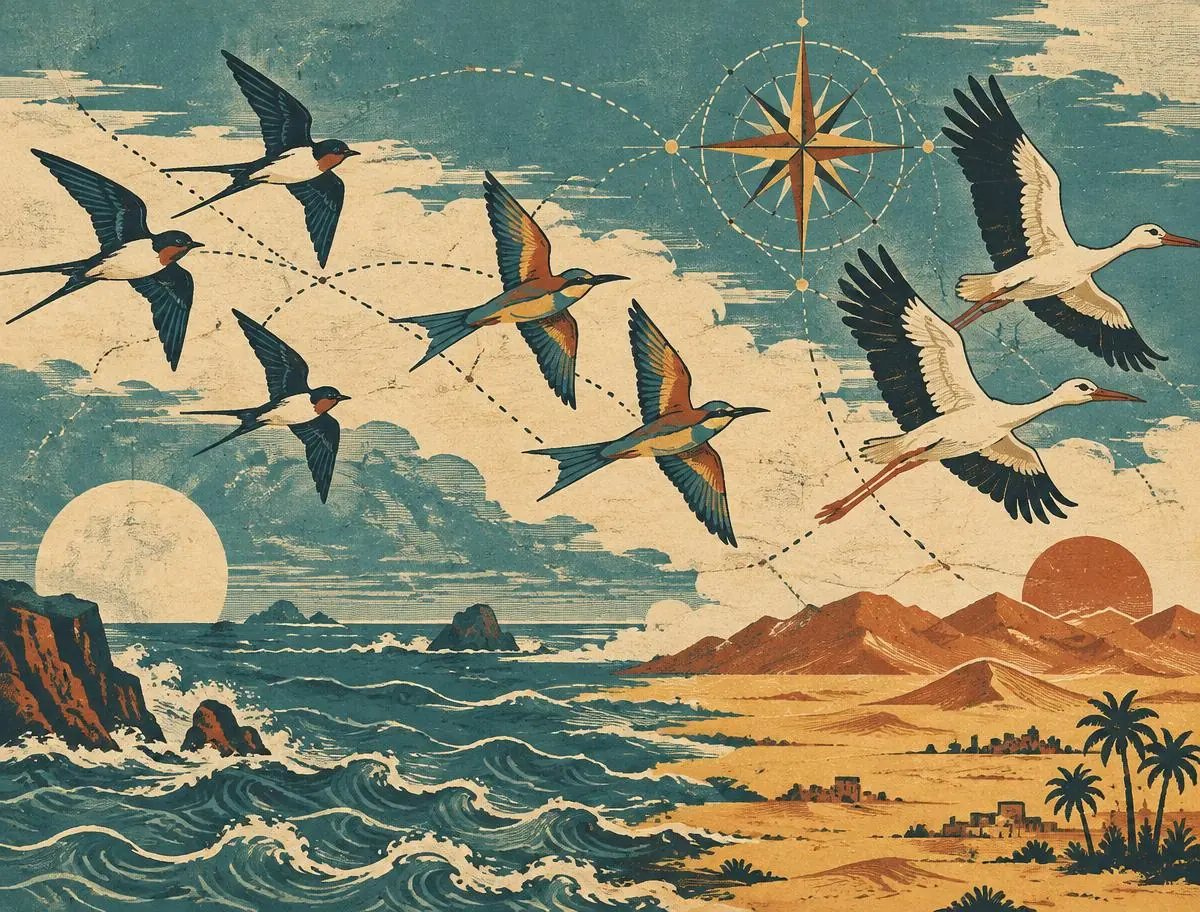
Five routes
Sahara, ocean, inheritance
A 2,000 km desert, a sea crossing to Madagascar, a record flight with a transformed body, and a route inherited without teachers.
06 · European bee-eater: colors that cross the Sahara
The bee-eater is the only bird that makes a power line look like a jewelry display. Turquoise, ochre, chestnut and a black mask: a tropical-looking species that breeds in sandy banks across much of Spain and disappears toward sub-Saharan Africa in August.
It's spotted by call before color: a liquid, repeated "prruip" that carries far and, once learned, makes you look up without thinking. It breeds in colonies, digging burrows over a meter long into earthen banks, and hunts bees, wasps and dragonflies in flight, striking them against a perch to disable the sting before swallowing them.
Its migration happens in loose flocks at good altitude, crossing the Mediterranean and the desert in stages. Over the Sahara there are no insects or shade: the trick is to travel with reserves, use the wind, and reach the savanna zones where food is plentiful again.
07 · Eleonora's falcon: the one that waits for migrants
This slender falcon flips the calendar. It breeds in late summer on cliffs and islets of the Mediterranean, including Balearic colonies, exactly when the sky fills with small migratory birds heading down toward Africa. Its chicks grow up with a full pantry.
It hunts over the sea, sometimes forming curtains of spaced-out falcons that intercept night migrants at dawn. It's one of the most impressive scenes anyone with binoculars can see from a headland: sharp silhouettes patrolling over open water.
When breeding ends, it makes its own extraordinary journey: it leaves the Mediterranean and crosses the continent to Madagascar and the Indian Ocean, one of the longest routes of any European raptor.
08 · Red knot: the bird that rebuilds itself
The red knot looks like just another wader in winter: gray, unremarkable, on the shoreline. In spring it lights up brick-red and sets off on an intercontinental journey between Arctic breeding grounds and temperate or tropical coasts.
Its secret is physiological. Before each leg it fattens up to nearly double its weight, shrinks muscles and organs it won't need, and rebuilds them on arrival. It depends entirely on a handful of tidal stopovers where it can eat mollusks at enormous speed: if one of those stops degrades, the whole chain breaks.
That's why it's a barometer species. A flock of knots resting on the beach isn't scenery: it's a pit stop running on reserve fuel. Every time it's flushed by an avoidable disturbance, it loses part of the fuel for the next leg.
09 · Common cuckoo: the map nobody taught it
The cuckoo lays its eggs in other species' nests and disappears. That means no young cuckoo travels with its parents or learns the route accompanied: when the time comes, it leaves Europe alone and finds Africa by instinct, orienting itself by the sun, the stars and the magnetic field.
Adults leave very early, sometimes in June or July, long before the young are ready. Tracking studies with transmitters have shown different outbound and return routes, extended stopovers in southern Europe to fatten up, and Sahara crossings made in a single push.
Its "cuck-oo" is heard for weeks and then goes silent all at once. That sudden silence at the end of spring is one of the most reliable clocks in the field.
10 · Greylag goose: traveling as a family
The greylag goose arrives in southern Europe with the cold, in noisy formations that can be heard for miles. Its migration is shorter than the others, but it has something they don't: it's a family affair. Young birds travel with their parents in their first year and learn roosts, feeding fields and specific routes.
That turns every flock into a library. Wintering traditions persist for decades, which is why conserving one specific wetland can change the fate of thousands of birds.
In marshes like the lower Guadalquivir, their arrival marks the season: they come in to roost at dusk, in waves, with a racket that needs no explanation. Dates and numbers change every year, so it's worth checking local counts.
Related designs
Frequently asked questions
When is the best time to see migration passage?
The passages from late August to October and from March to May are the most pronounced. Days with favorable wind concentrate movement at headlands and mountain passes.
How do I know if a flock is resting or feeding?
If they're still, with their bill under a wing or motionless at the water's edge, they're recovering. Keep your distance: that rest is part of the journey.
Where can I check real routes?
Tracking programs and open databases like eBird publish up-to-date records and maps by species.
Watching passage without draining energy
These birds arrive with their reserves counted. Watch from a distance, use hides, and don't force flights for a photo: every avoidable takeoff is paid for in kilometers.
The full collection brings together ten routes and ten garments, one per journey.
View the Migration is Natural collection