
Field Notes · Migration
Why Some Birds Cross Half the Planet
The short answer: because food and light shift, and birds follow them. When the north runs out of insects, fish, and daylight hours, staying costs more energy than flying. Migration isn't a heroic whim; it's the most effective way many birds have found to live twice a year.
What's extraordinary isn't that they do it, but how: reading stars and magnetic fields, inheriting maps, gliding on staircases of hot air, or flying eleven days without touching land. These five stories belong to the birds featured in our first five Migration is Natural designs, and each one starts with a simple question: how far can a bird go?
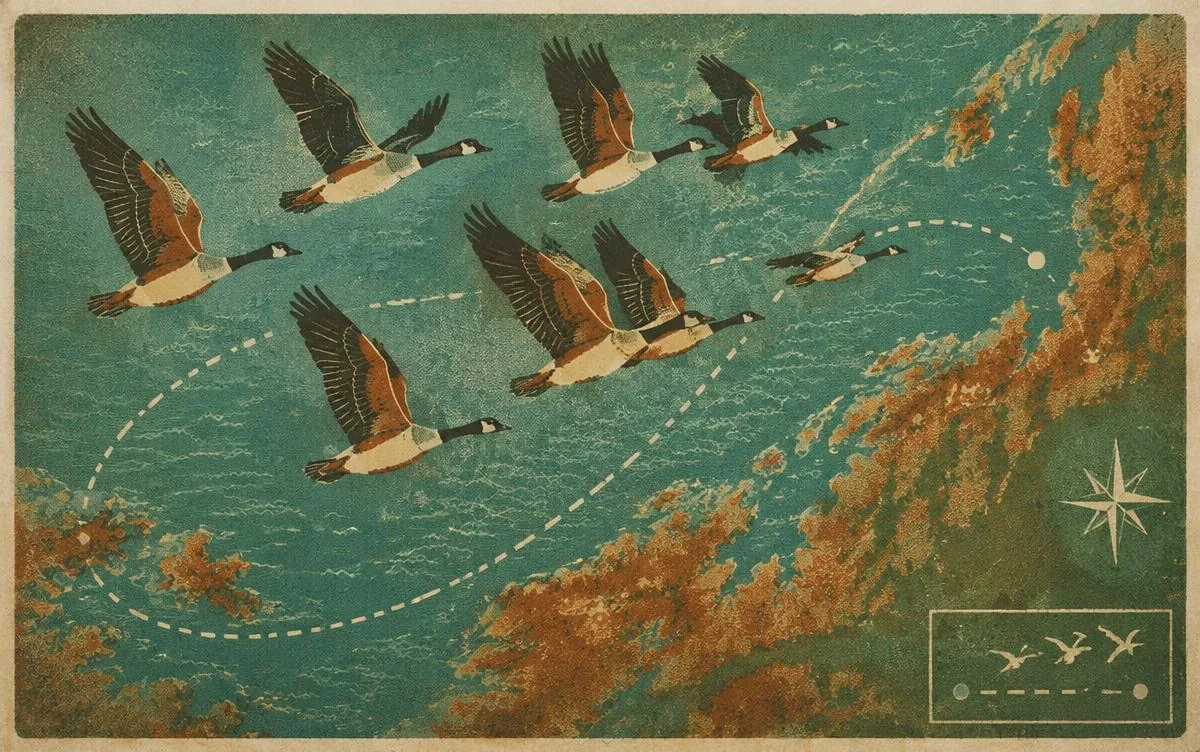
Five birds, five routes
Pole to pole
Over 70,000 km a year for the Arctic tern, 13,500 km non-stop for the bar-tailed godwit, and three more travellers that turn Europe, Africa and the Pacific into a single map.
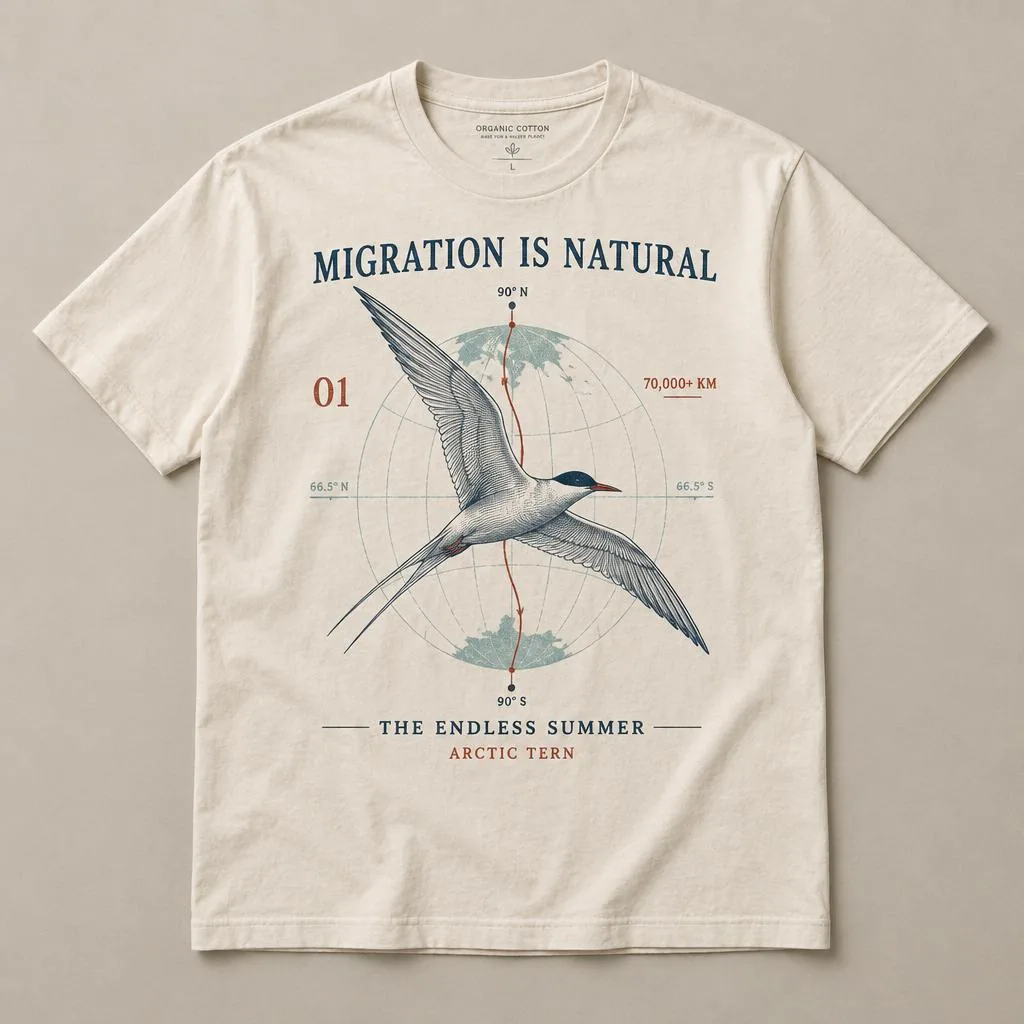
01 · The Endless Summer
· Arctic tern
The Arctic tern is born under the midnight sun and decides, every year, that one summer isn't enough. When the Arctic starts closing in, it takes flight and crosses the entire planet to Antarctica, chasing the light all over again. It's the longest known migration: more than 70,000 kilometres pole to pole, round trip, over an ocean that offers not a single perch.
Over its lifetime — which can exceed thirty years — a tern racks up the equivalent of several round trips to the Moon. And it does it with the body of a small gull, fishing on the move, sleeping in flight, and reading winds that we only see on weather maps.
Field note: it doesn't fly in a straight line. It traces a huge S-shape across the Atlantic to ride prevailing winds, heading down via Africa or the Americas depending on the individual.
View design 01 in the shop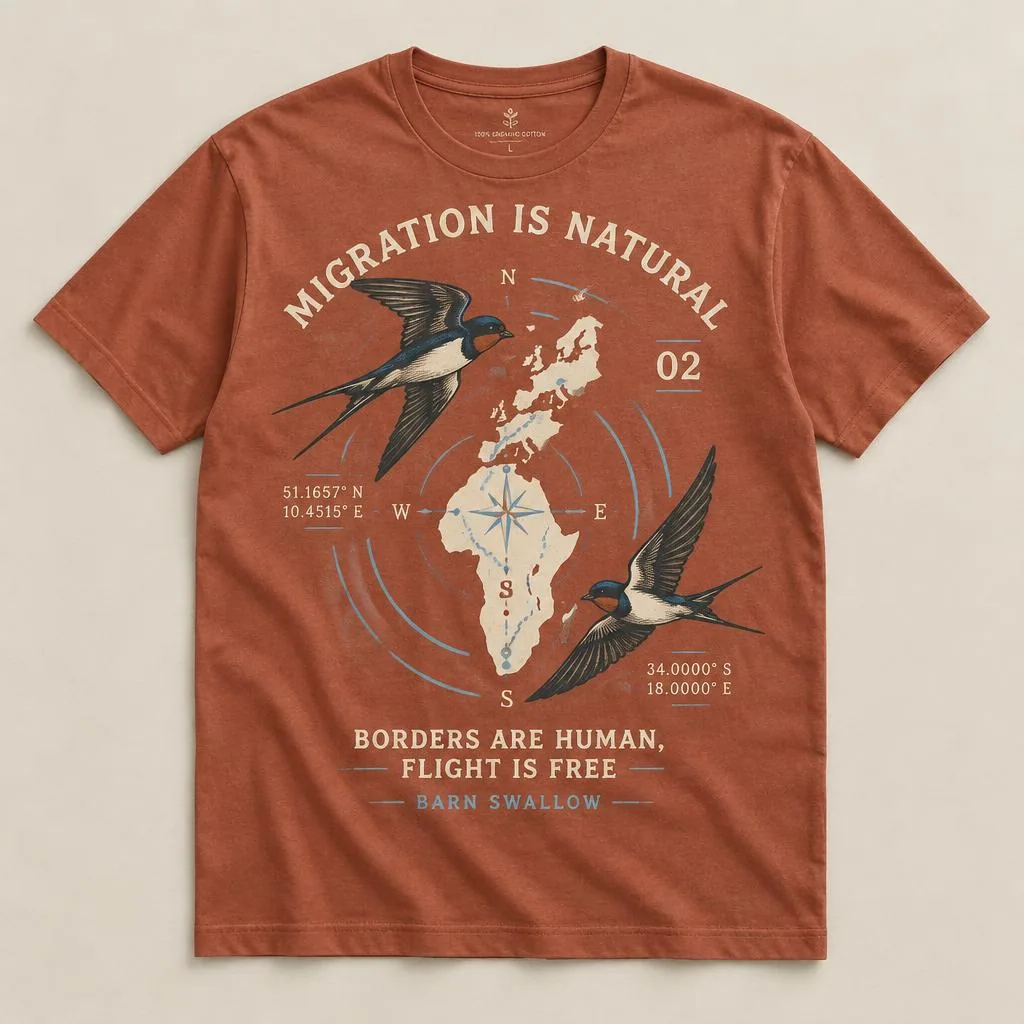
02 · Borders Are Human, Flight Is Free
· Barn swallow
The barn swallow nests under our eaves and bridges, so close that we think we know it. But every summer's end it disappears, and what it actually does is cross Europe, the Mediterranean, and the Sahara Desert all the way to the savannas of southern Africa. The eaves-dwelling bird is, in fact, an intercontinental traveller.
It crosses borders because it doesn't see them: it sees air currents, clouds of insects, and riverbeds it uses as highways. In spring it often returns to the very same barn and the same mud nest from the year before. If a swallow has chosen you, it will most likely come back.
Field note: swallows eat, drink, and even bathe in flight, skimming the water's surface without landing. Solid ground is, for them, almost a formality.
View design 02 in the shop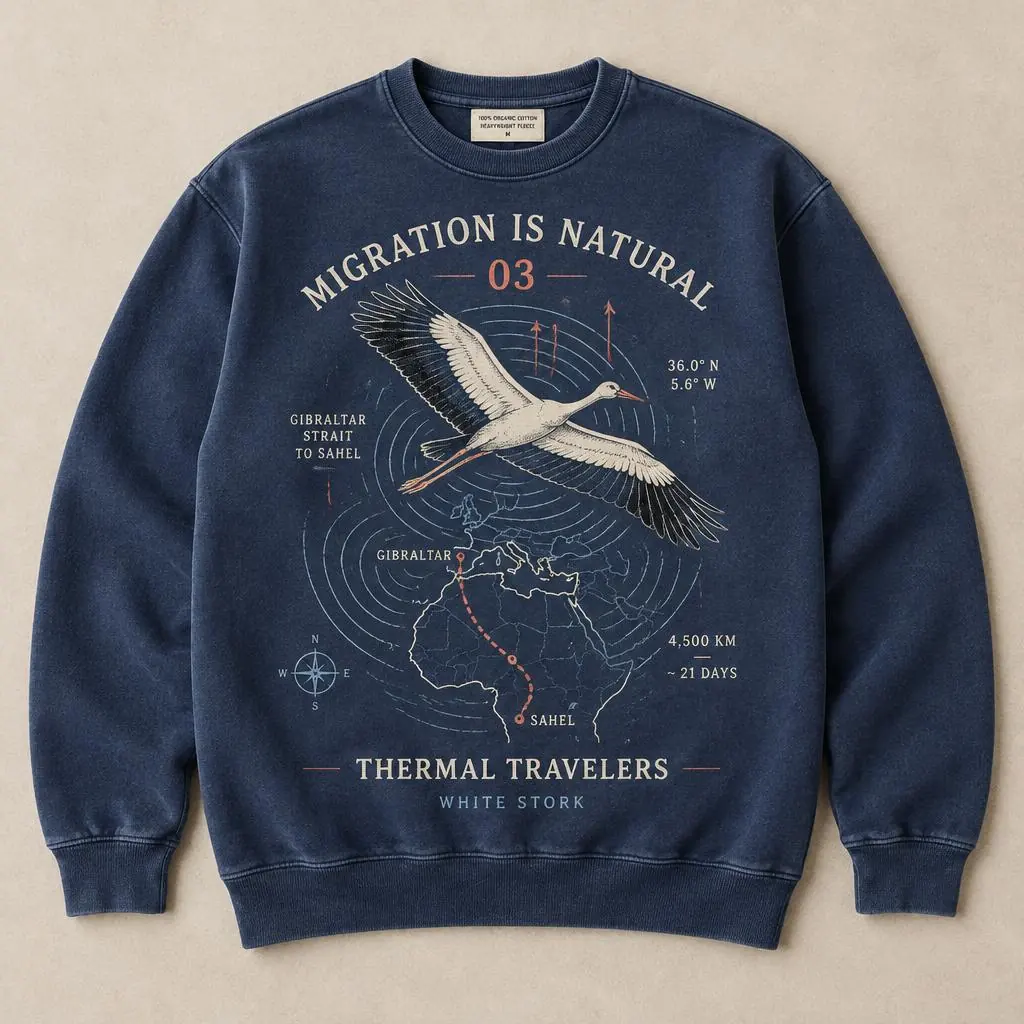
03 · Thermal Travelers
· White stork
The white stork is too big and too much of a glider to flap its wings over open sea. So it does something more elegant: it spirals upward inside columns of hot air, glides on to the next one, and strings thermal after thermal together like climbing an invisible staircase thousands of kilometres long.
That trick has a geographic consequence: thermals don't form over water, so all of western Europe's storks converge at the same bottleneck. On good migration days, thousands of storks gather over the Strait of Gibraltar, waiting for exactly the right wind to cross into Africa and continue to the Sahel.
Field note: at the Strait they don't just watch the wind — they'll wait entire days if needed. Migration for a glider is, above all, an exercise in patience.
View design 03 in the shop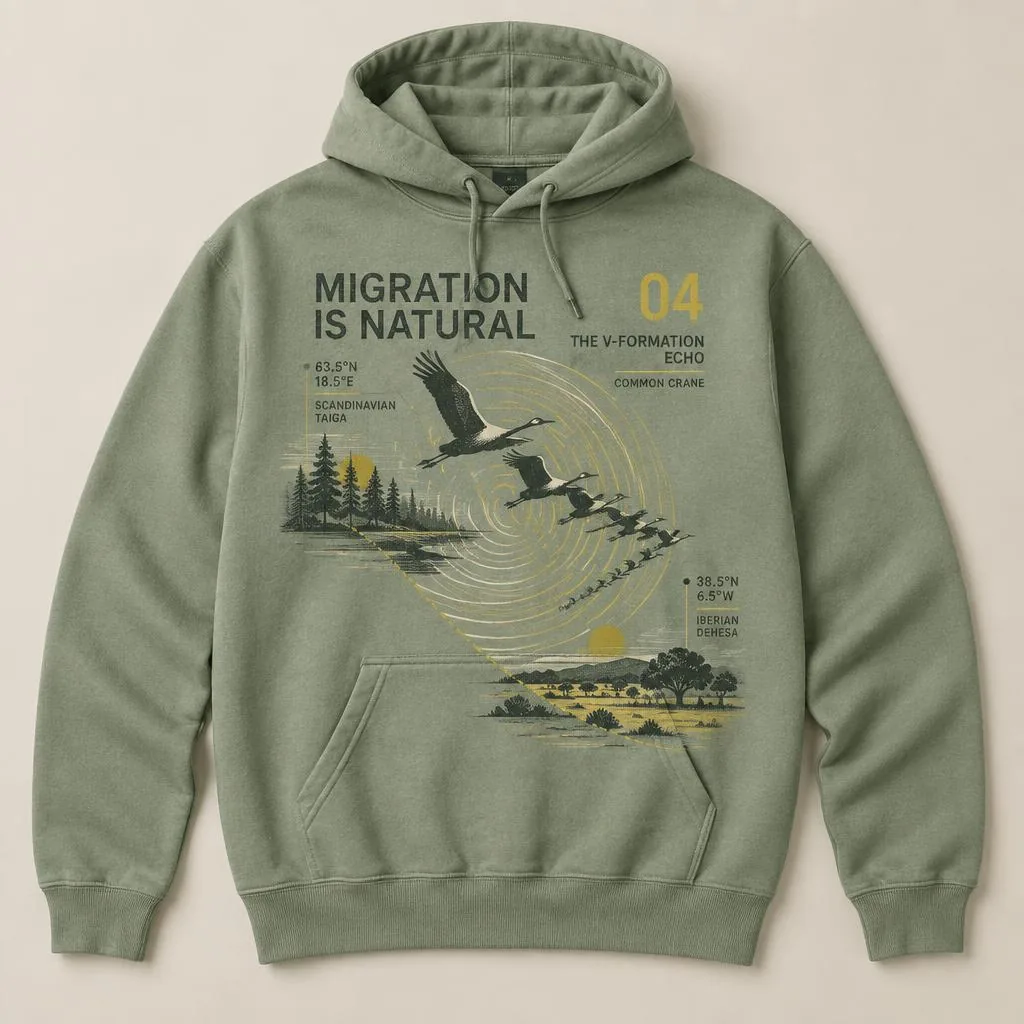
04 · The V-Formation Echo
· Common crane
You hear the common crane before you see it. On grey European autumn days, a distant bugling call crosses the sky and, if you look up, the great V formation appears: hundreds of birds from the Scandinavian taiga travelling as families toward the Iberian oak meadows, taking turns at the front because no one can shoulder all the effort alone.
The V isn't for looks — it's engineering. Each crane flies in the upward draft left by the wing of the bird ahead, saving energy on every flap. Young cranes learn the route by travelling with their parents, corridor by corridor, roost by roost, in a tradition passed down generation after generation.
Field note: when cranes arrive to roost at inland lagoons and fields, they do so in flocks so noisy the entire evening feels like a conversation.
View design 04 in the shop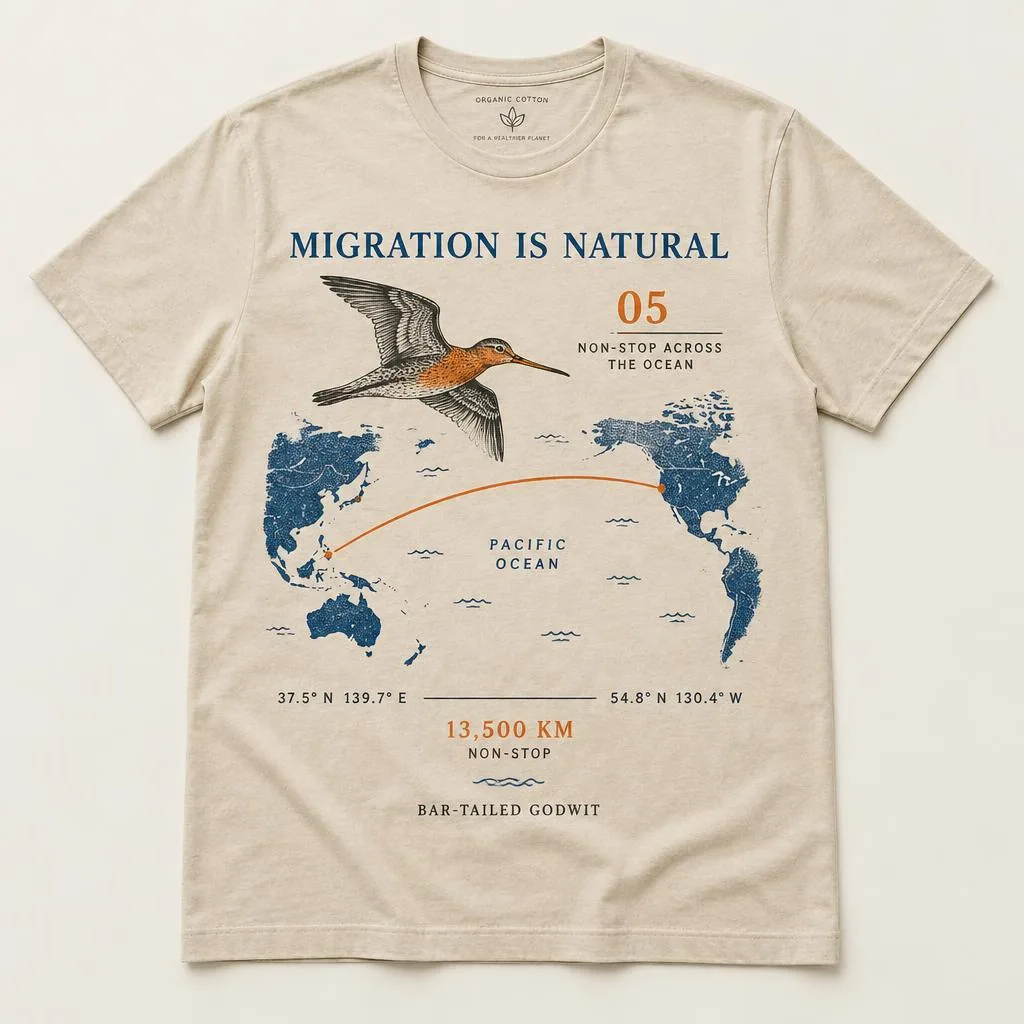
05 · Non-Stop Across the Ocean
· Bar-tailed godwit
If the other stories are impressive, this one borders on impossible. The bar-tailed godwit — a pigeon-sized wader — leaves Alaska, launches out over the open Pacific, and doesn't touch land again until New Zealand. About 13,500 kilometres straight through: eight, nine, up to eleven days flying without eating, drinking, or resting. It's the longest non-stop flight in the animal kingdom.
To pull it off, the bird transforms before departing: it doubles its weight in fat, shrinks organs it won't need in flight, and turns almost its entire body into fuel and muscle. It flies through cyclones, corrects course using the magnetic field and the stars, and arrives on the other side of the world having lost half of itself along the way.
Field note: on arrival, the godwit spends its first hours feeding, barely lifting its head from the mud. After eleven days over the ocean, the shore isn't a landscape — it's a feast.
View design 05 in the shopWatching migration without disturbing it
Migratory birds arrive exhausted and with barely any reserves left. If you see a roost or a flock resting on the shore, keep your distance: every flight we cause is energy they'll be missing for the next leg. The best migration days are enjoyed with binoculars, patience, and the wind in your face.
To follow real routes and records, platforms like eBird and BirdLife tracking programmes publish up-to-date data on these same species.
View the Migration is Natural collection