Field Notes · Method
The notebook that makes you a better birder
Always note four things: a header (date, place, start and end time, weather), a species list with rough numbers, a description of anything you can't identify, and a quick sketch of what's in doubt. Ten minutes of notes are worth more than two hundred photos with no context.
The notebook isn't an archive — it's training. Describing forces your eye to look for what matters, and that changes the way you look the very next day.
Template
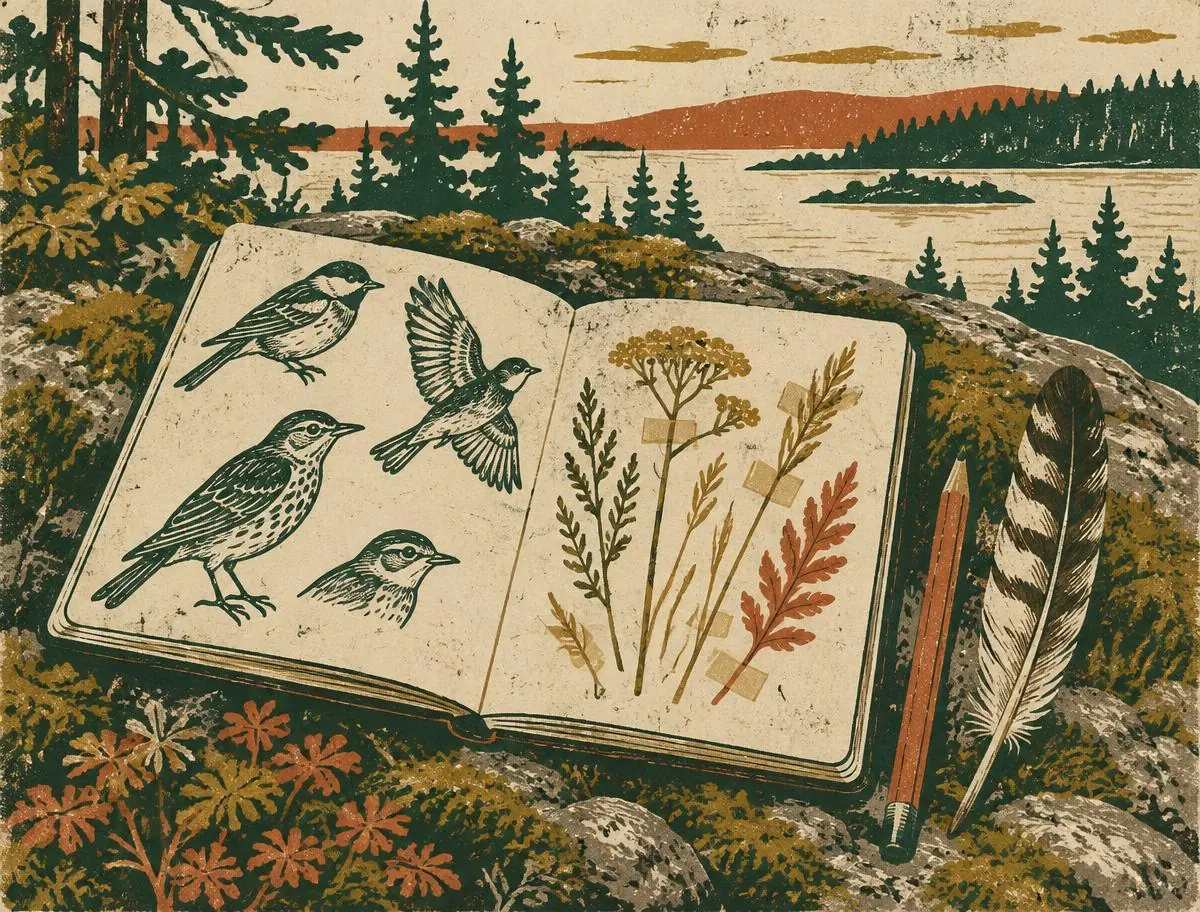
Header, list, doubts, sketch
Date, place, times and weather up top. Species with rough counts. Descriptions of what you couldn't identify. A drawing, even a bad one.
What goes in the header of each outing?
Date, exact place, start and end time, and conditions: wind, cloud, rough temperature, whether it rained beforehand. Add the route in one line: "north hide and the bank path, there and back."
That block feels like bureaucracy until you've kept it up for a year. Then it lets you compare: the same lagoon with a north wind and with no wind are two different places, and your notes prove it with names and numbers.
Also note the effort: how many minutes you actually spent watching. That's the figure that makes your lists comparable, genuinely yours, and useful for citizen science if you ever share them.
How do you record species and numbers?
One line per species and a figure, even a rough one. "Mallard: about 40" is better than "quite a few". If you're estimating, say so: "c. 300 starlings" makes clear it's a calculation.
Count in blocks of ten or a hundred when the flock is large. And separate what you see from what you hear with a simple mark: an "h" for heard, a "s" for seen. That detail is very useful in woodland, where half your list is acoustic.
Flag relevant behaviour: breeding (birds carrying material or food), courtship, feeding, a flock on passage, a roost. "5 house martins entering a nest" is a breeding record; "5 house martins" is just a number.
What do you write when you don't know what a bird is?
Describe without naming it. Size by comparison (smaller than a sparrow, blackbird-sized), bill shape, tail and leg length, exact habitat, the height it was at and what it was doing. Add the sound as your own onomatopoeia.
Then, if you like, write your guess in brackets: "(chiffchaff?)". Keeping the description separate from the conclusion is what stops your memory from rewriting what you saw — which happens more often than we think.
Record what you couldn't confirm: "didn't see the wing covert", "full backlight". Acknowledging the limits of an observation is what keeps your notes reliable five years from now.
Do you need to know how to draw?
No. An oval, a head, a tail and two wing strokes are enough. What matters is getting the proportions right and placing the markings you saw, not making art. An ugly sketch with three arrows and notes is an excellent identification tool.
Drawing forces you to look at structure: is the bill as long as the head? Does the tail project beyond the closed wings? Do the legs show in flight? Questions you never ask if you just fire off the camera.
One trick: draw first, check the guide after. If you check the guide first, your drawing will end up looking like the book's illustration instead of what was actually in front of you.
Paper or phone? And what do you do once you're home?
Paper for the field, digital for the archive. A small notebook and pencil work in the cold, in the rain and with no battery, and won't distract you with notifications right as the flock comes in. Pencil even writes on wet paper.
Once home, write the list up cleanly the same day, while you still remember the details. That's the moment to settle doubts with the guide, mark what's still pending and add what you learned. Fifteen minutes on the sofa close the learning loop.
Every so often, reread a whole month. You'll spot patterns you missed: arrival dates, species that vanished, spots that always deliver more. That's where the notebook stops being a habit and starts being knowledge.
Quick checklist before you go
- A small notebook and a pencil, not a pen.
- A full header before you start watching.
- A seen or heard mark on every species.
- Rough figures, flagged as estimates.
- Description before name for anything in doubt.
- Write it up cleanly the same day.
Frequently asked questions
How long does good note-taking take?
Five minutes in the field and ten once you're home. Less time than it takes to go through photos.
Is it worth uploading lists to eBird?
Yes, if you include effort and route. That way your data is useful to others and you keep a tidy history.
What do you do with rare sightings?
Describe it in full detail, sketch it and photograph it if you can. And check with your local birding group before treating it as confirmed.
Writing is looking twice
Whoever takes notes learns twice as fast, because describing forces you to notice what actually identifies a bird.
And if you also learn to recognise songs, your list will grow without you needing to see a single extra feather.
Back to Field Notes