Field Notes · City
Your neighbourhood is a birding spot
You don't need a car or a heroic early start. With twenty minutes, a park with water and the habit of looking up, you learn more than in one trip a year. The city has a huge advantage: you can repeat the same route a hundred times and notice the changes.
Repetition is what turns a walk into data. Once you know your route, you spot the newcomer on day one.
Minimum plan
Twenty minutes, same route
A fixed twenty-minute route, two or three times a week, always at the same time. It's the best learning method there is for a beginner.
Where should you look in a city?
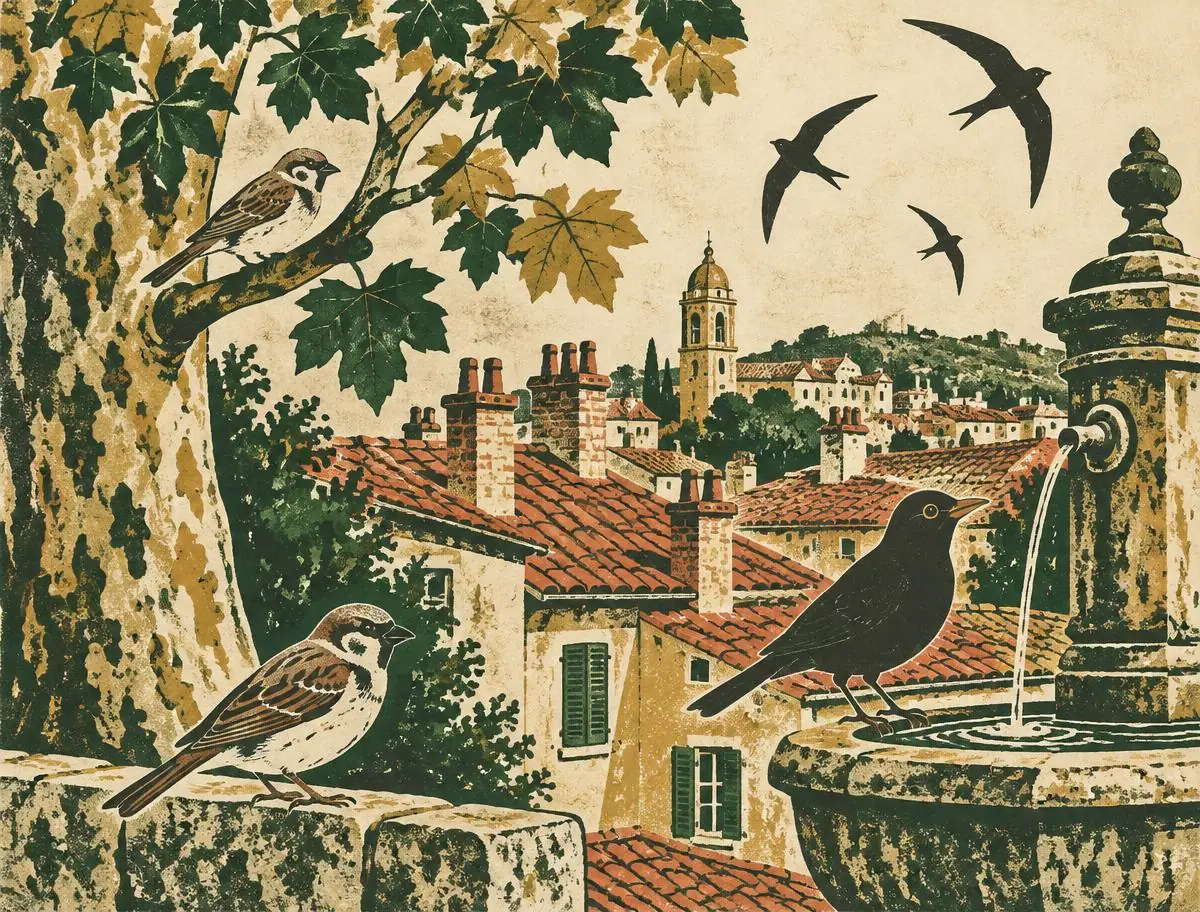
Look for water, food and gaps. Water: fountains, ponds, canals, puddles that linger after rain. Food: hedges with berries, fig trees, mulberries, bins, freshly watered lawns. Gaps: ledges, scaffolding holes, shutter boxes and old rooftops, where swifts, martins and sparrows nest.
Vacant lots are gold. A scrubby lot amid the asphalt concentrates redstarts, warblers on passage, stonechats and pipits in winter. That kind of spot usually vanishes the moment it's built on, so make the most of it while it lasts.
Don't forget the sky. Swifts in spring and summer, gulls crossing at dusk towards tips or roosts, storks on towers and, with luck, kestrels and peregrine falcons hunting between buildings. Peregrines breed on bell towers and office blocks in several European cities; check your local birding records.
What's the best time in the city?
First thing, before the traffic. In the city the limiting factor isn't light, it's noise: at seven you hear songs that by nine are lost under the cars. An urban park early on is a different place altogether.
Dusk works too, but for something else: roost movements. Flocks of starlings, sparrows gathering in one particular hedge, gulls in lines and swifts screaming overhead. Find your neighbourhood's roost and you'll have guaranteed spectacle for months.
After a summer rain, head out twenty minutes later. Wet grass brings up invertebrates and birds come down to the ground, closer and more visible.
Which species can you get to know well without travelling?
The so-called common ones, which are the ones that really teach you to look. Blackbird, house sparrow, serin, great tit, blue tit, white wagtail, black redstart, starling, magpie, woodpigeon and common swift form the usual core of many Iberian cities.
Pay attention to behaviour, not just the name. The black redstart constantly quivers its tail; the wagtail walks bobbing its tail up and down; the blackbird runs in hops and stops dead. Learning these gestures is the foundation for identifying rarer species later, because almost everything is recognised by how it moves.
Note first and last dates. Swifts' spring arrival and summer departure vary by location; record what happens on your route. With two or three years of notes you have a data series no field guide can give you.
Can my neighbourhood list actually be useful?
Yes. Repeated urban counts are useful data for tracking declining species. Citizen science programmes from BirdLife-affiliated organisations let you contribute observations of house sparrows and other urban birds through comparable surveys.
You can upload your lists to open platforms like eBird, noting the route and time spent. A short but honest list, with declared effort, is worth more than a long list with no context.
And there's something very practical: when you document breeding colonies on a lot or on ledges, that information can influence building and renovation decisions. The gaps where swifts and martins nest are often lost in facade renovations, and simple solutions exist if someone flags it in time.
How do you watch without disturbing people in an inhabited area?
Keep your distance from nests and never point binoculars at windows: it sounds obvious, but it's the most common complaint about urban birdwatching. If you're watching a ledge, explain it naturally to anyone who asks; in the city, telling people what you're doing usually sparks curiosity, not rejection.
Don't feed bread to ducks or sparrows. Feeding bread harms birds and attracts rats and gulls. If you really want to help, a clean water dish in summer does more than any bag of crumbs.
With chicks on the ground in spring, the norm is not to touch them: many fledglings leave the nest before they can fly well, and their parents keep feeding them. If there's a real risk from a car or a cat, move it the minimum distance to a nearby safe spot and leave it there.
Quick checklist before you go
- A fixed twenty-minute route chosen and noted down.
- Head out early, before the traffic.
- Light binoculars always in your daily bag.
- A notebook or phone notes with time and duration.
- No bread; a clean water dish in summer.
- Nesting ledges and gaps located and respected.
Frequently asked questions
Is it worth birdwatching in the city?
Yes. It's where you'll learn to identify by behaviour, because you can see the same species dozens of times.
What should I do if I see an injured bird?
Handle it as little as possible and call your local environmental emergency line or a wildlife rehabilitation centre.
Can I do a survey on my own?
Yes: same route, same time, same duration, and note down everything you detect. Consistency is what gives the data its value.
Start where you live
The best birding spot isn't the most famous one: it's the one you can visit on a Tuesday morning before work.
Once you've mastered your neighbourhood, the natural next step is a nearby wetland in winter.
View the Urban Birds collection